
The Christopher Columbus PSK Award (CCPA) is dedicated to the DXCC entities associated with Christopher Columbus’s four Atlantic voyages (1492–1504) and is structured around territories personally reached, landed upon, or clearly documented along his route.
The award may be claimed by any licensed radio amateur, club station, or DMS (SWL) eligible under the EPC Awards General Rules who can produce an ADIF log showing contacts with, or monitoring of, amateur radio stations from 20 different DXCC entities from the Christopher Columbus List.
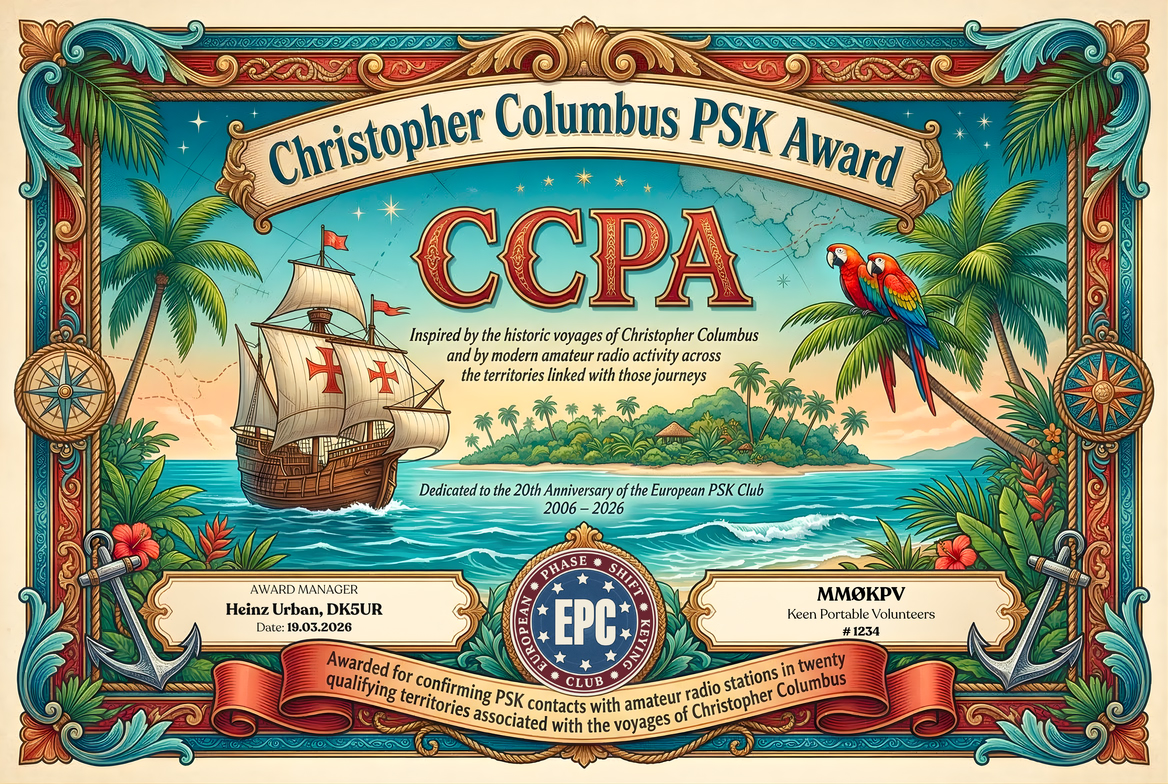
- The CCPA may be claimed by any licensed radio amateur, club station, or DMS (SWL) eligible under the EPC Awards General Rules.
- All operation must comply with the station licence and the general EPC award framework.
- The applicant must submit evidence of having contacted or monitored amateur radio stations from at least 20 different DXCC entities listed in the CCPA Christopher Columbus List.
- Each DXCC entity counts once toward the qualification total.
- Contacts and SWL receptions must be documented in ADIF format.
- QSOs are valid on any PSK modes and at any baud rates.
- Credit is valid on any amateur radio band below 54 MHz.
- Mixed-band and mixed-mode submissions are permitted.
- Applications should be prepared in accordance with the EPC Awards General Rules.
- The award manager may inspect doubtful entries and request clarification where necessary.
- Unless announced otherwise, the award is issued through the EPC award management environment.
The CCPA is based on documented points from Columbus’s four voyages: the Iberian departure from Spain; Atlantic staging and return points including the Canary Is., Azores, and Portugal; the first Caribbean landfalls in the Bahamas, Cuba, and Hispaniola; the second-voyage passage through the Lesser Antilles including Dominica, Guadeloupe, Antigua & Barbuda, the Virgin Islands, and Puerto Rico; the third-voyage reach to Trinidad & Tobago and the coast of Venezuela; and the fourth-voyage exploration of mainland Caribbean Central America including Honduras, Nicaragua, Costa Rica, and Panama, with Jamaica prominent in the final phase.
For this award, every place is mapped only to its present-day ARRL DXCC current entity. The list deliberately favors historically documented landfalls and route points directly associated with Columbus himself.
- Spain — expedition departure and return context under the Catholic Monarchs.
- Canary Is. — regular Atlantic staging point before westbound crossings.
- Azores — important return-route Atlantic stop after the first voyage.
- Portugal — Lisbon reached after the stormy first-voyage return.
- Bahamas — first documented landfall in the Caribbean in October 1492.
- Cuba — major first-voyage exploration area and revisited later.
- Haiti — part of Hispaniola’s north coast explored on the first voyage.
- Dominican Republic — Santo Domingo / Hispaniola focus of later voyages.
- Dominica — named and landed during the second voyage.
- Guadeloupe — explored during the second-voyage Lesser Antilles passage.
- Antigua & Barbuda — named in the same second-voyage island arc.
- Virgin Is. — Saint Croix and the Virgin Islands chain documented on the second voyage.
- British Virgin Is. — Virgin Gorda lies within the chain named by Columbus.
- Puerto Rico — reached during the second voyage.
- Jamaica — visited and later central to the final voyage’s survival episode.
- Martinique — landfall on the fourth voyage before Hispaniola.
- Trinidad & Tobago — third-voyage landfall at Trinidad.
- Venezuela — Gulf of Paria and Paria Peninsula on the third voyage.
- Honduras — mainland Central American coast reached on the fourth voyage.
- Nicaragua — explored along the Mosquito Coast during the fourth voyage.
- Costa Rica — continued mainland coastal exploration during the fourth voyage.
- Panama — Veragua and nearby coast visited during the fourth voyage.
| Amateur Radio Prefix | Territory Name | Explanation | Territory Code |
|---|---|---|---|
| EA-EH, AM-AO | Spain | Departure and return context of the Columbian voyages. | CC-ESP |
| EA8, AM8, AO8 | Canary Is. | Atlantic staging point before westbound crossings. | CC-CAN |
| CU-CW | Azores | Atlantic stop reached on the return from the first voyage. | CC-AZO |
| CT, CQ | Portugal | Lisbon reached after storm conditions on the first-voyage return. | CC-PRT |
| C6 | Bahamas | First Caribbean landfall of October 1492. | CC-BAH |
| CO, CM, T4 | Cuba | Major exploration area on the first voyage and revisited later. | CC-CUB |
| HH | Haiti | North-western coast of Hispaniola explored on the first voyage. | CC-HAI |
| HI | Dominican Republic | Santo Domingo and broader Hispaniola focus on later voyages. | CC-DOM |
| J7 | Dominica | Named and landed during the second voyage. | CC-DMA |
| FG | Guadeloupe | Explored during the second-voyage Lesser Antilles passage. | CC-GUA |
| V2 | Antigua & Barbuda | Named in the second-voyage island arc. | CC-ATG |
| KP2 | Virgin Is. | Saint Croix and the Virgin Islands chain documented on the second voyage. | CC-USV |
| VP2V | British Virgin Is. | Virgin Gorda and nearby islands associated with the named Virgin Islands chain. | CC-BVI |
| KP3, KP4 | Puerto Rico | Reached on the second voyage. | CC-PUR |
| 6Y | Jamaica | Visited earlier and central to the final voyage’s marooning episode. | CC-JAM |
| FM | Martinique | Landfall on the fourth voyage in June 1502. | CC-MRT |
| 9Y-9Z | Trinidad & Tobago | Third-voyage landfall at Trinidad. | CC-TTO |
| YV-YY, 4M-4I | Venezuela | Gulf of Paria and Paria Peninsula reached on the third voyage. | CC-VEN |
| HR | Honduras | Mainland Central American coast reached on the fourth voyage. | CC-HON |
| YN, H6-H7 | Nicaragua | Mosquito Coast explored during the fourth voyage. | CC-NIC |
| TI, TE | Costa Rica | Continuing mainland coastal exploration on the fourth voyage. | CC-CRC |
| 3E, 3F, h9, H8, H9, HO-HP | Panama | Veragua and neighboring coast reached on the fourth voyage. | CC-PAN |
Note: the list intentionally follows the ARRL DXCC current entity list and includes only territories directly tied to Columbus’s documented route.
