

The NPPA translates the life and expeditions of Nikolay Przhevalsky into a modern territory award for radio amateurs. The list is deliberately built from the documented biographical route: Smolensk and the family estates, early military service in Moscow, Belyov, Bely, Kremenets, Warsaw and Piotrków, the Ussuri and Primorye journeys, and the successive Central Asian expeditions through Kyakhta, Urga, Kalgan, Beijing, Dalai-Nur, Alashan, Kokonor, Qaidam, Tibet, Ili, Lop Nor, Yulduz, Guchen, Zaysan, Hami, Dunhuang, the upper Yellow River, Issyk-Kul, Karakol and the final 1888 Ak-su – Hotan – Keriya – Cherchen – Gasa plan.
Qualification for the NPPA is based only on working 30 different territories from the valid NPPA list below. Because many expedition sectors lie within the same modern country, the territory reference is determined by the NPPA code rather than by prefix uniqueness alone.
Applicants should submit an ADIF log showing PSK QSOs from any 30 different valid territories out of the 65 listed below. For reliable checking, each claimed QSO should carry the territory reference in the COMMENT field, for example #NPPA NP-01 ... #NPPA NP-65.
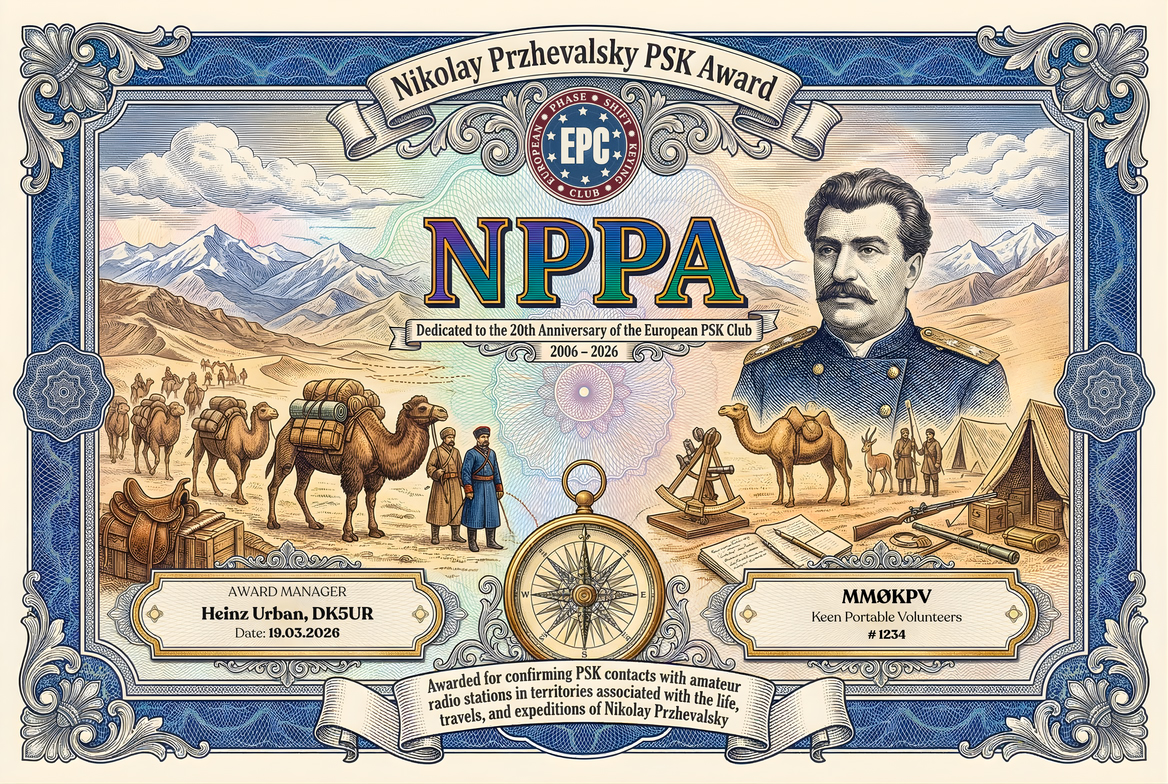
- The NPPA may be claimed by any licensed radio amateur, club station, or eligible SWL / DMS operator under the applicable EPC general rules.
- All operation must comply with the operator’s licence conditions and the relevant award framework.
- The applicant must provide evidence of having contacted amateur radio stations from any 30 different valid NPPA territories listed in the table below.
- The valid list contains 65 territories in total.
- Each territory counts only once toward qualification.
- Contacts must be documented in ADIF format.
- It is recommended that the applicant uses the COMMENT field in the format #NPPA NP-01 ... #NPPA NP-65 to identify the claimed territory clearly.
- Only PSK contacts are valid for this award.
- Any PSK variant and any baud rate may be used.
- Credit is valid on amateur bands below 54 MHz.
- Mixed-band submissions are permitted.
- This award is based on a defined NPPA territory list rather than on DXCC entities alone.
- The list combines modern administrative units, cities, prefectures, lakes, basins, mountain sectors and expedition corridors that are materially connected to Przhevalsky’s life and journeys.
- The displayed prefix shows the correct modern amateur-radio prefix family for the relevant country or region grouping; where several territories belong to the same modern prefix area, the NPPA code is the decisive award reference.
| Prefix | Territory | NPPA Code | Modern Type | How it relates to Przhevalsky |
|---|---|---|---|---|
| R3L | Smolensk Oblast, Russia | NP-01 | Oblast | Birth region: Kimboryovo near today’s Murygino, study at Smolensk Gymnasium, family estates Otradnoye and later Sloboda/Przhevalskoye. |
| R3A | Moscow, Russia | NP-02 | Federal City | Entered military service here in 1855; also passed repeatedly through Moscow on expedition departures and returns. |
| R3P | Tula Oblast, Russia | NP-03 | Oblast | Served at Belyov in the reserve Belyov Regiment in 1855–1856. |
| R3I | Belsky District, Tver Oblast | NP-04 | District | Served with the 28th Polotsk Infantry Regiment at Bely before its later transfer west. |
| UR5B | Ternopil Oblast, Ukraine | NP-05 | Oblast | The 28th Polotsk Regiment was stationed at Kremenets from 1860; Przhevalsky served there. |
| R1A | Saint Petersburg, Russia | NP-06 | Federal City | General Staff Academy, scientific reporting, publications, expedition preparation, and repeated post-expedition residence. |
| SP5 | Masovian Voivodeship, Poland | NP-07 | Voivodeship | Attached to the Warsaw Infantry Junker School in 1864–1866; taught history and geography there. |
| SP7 | Łódź Voivodeship, Poland | NP-08 | Voivodeship | His regiment was redeployed to Piotrków (Petrokov), where he remained on the regiment lists while serving in Warsaw. |
| R9J | Tyumen Oblast, Russia | NP-09 | Oblast | Passed through Tyumen on the overland route east during the first Central Asian expedition. |
| RØS | Irkutsk Oblast, Russia | NP-10 | Oblast | Reached Irkutsk in 1867; headquarters link for the Ussuri mission and later a major reporting point after expeditions. |
| RØC | Khabarovsk Krai – Khabarovsk sector, Russia | NP-11 | Krai / route sector | Stayed at Khabarovka in January 1868 during the Ussuri expedition. |
| RØL | Primorsky Krai – Ussuri Sector, Russia | NP-12 | Route Sector | Core territory of the 1867–1869 Ussuri explorations; surveyed routes and settlements toward Manchuria and Korea. |
| RØL | Primorsky Krai – Lake Khanka Sector, Russia | NP-13 | Lake / Route Sector | Repeatedly studied the Khanka area, especially bird migration and natural history. |
| RØL | Primorsky Krai – Busse Sector, Russia | NP-14 | Route Sector | Reached the Cossack settlement of Busse on the upper Ussuri. |
| RØL | Primorsky Krai – Partizansk / Suchan Basin, Russia | NP-15 | Route Sector | In 1868 he joined operations against honghuzi gold raiders in the Suchan basin and reconnoitred routes toward the coast. |
| RØC | Khabarovsk Krai – Nikolayevsk-on-Amur Sector, Russia | NP-16 | Route Sector | Spent the winter of 1868–1869 in Nikolayevsk, processing collections and drafting his Ussuri materials. |
| R9M | Omsk Oblast, Russia | NP-17 | Oblast | Passed through Omsk on the west-to-east route during later Central Asian journeys. |
| UN7D | Abai Region, Kazakhstan | NP-18 | Region | Crossed Semipalatinsk/Semei on the approach to Kulja and Zaysan sectors. |
| UN7J | East Kazakhstan Region – Zaysan Sector, Kazakhstan | NP-19 | Region / Lake Sector | Zaysan was a key staging point, especially for the 1879–1880 expedition. |
| UN7Q | Almaty Region, Kazakhstan | NP-20 | Region | Passed the Altyn / Altýn corridor on the way to Verny and Kulja in 1876. |
| UN7G | Almaty City, Kazakhstan | NP-21 | City / Historic Verny | Reached historic Verny in 1876; also connected with the final 1888 journey. |
| JT5 | Selenge Province, Mongolia | NP-22 | Province | Kyakhta crossing led directly into northern Mongolia; the main corridor south ran through this province. |
| JT1 | Ulaanbaatar, Mongolia | NP-23 | Capital / Historic Urga | Urga was one of the principal route anchors on several expeditions. |
| JT4 | Ömnögovi / central Gobi route, Mongolia | NP-24 | desert route sector | Crossed central Gobi sectors during returns and through-routes between China and Urga. |
| JT3 | Dornogovi / Southeastern Gobi Route, Mongolia | NP-25 | Desert Route Sector | Part of the Kalgan–Urga–Kyakhta corridor used in the first expedition. |
| BY1 | Beijing, China | NP-26 | Municipality | Reached Beijing in January 1871; prepared the first big Central Asian expedition there and used the Russian mission house as base. |
| BY3 | Hebei – Zhangjiakou / Kalgan, China | NP-27 | Province / Route Sector | Kalgan was a key staging point on both outward and return travel. |
| BY3 | Inner Mongolia – Dalai Nur Sector, China | NP-28 | Lake / Route Sector | The first expedition moved toward the north shore of Lake Dalai-Nur. |
| BY3 | Inner Mongolia – Suma-Hodi Sector, China | NP-29 | Mountain / Route Sector | Explored the Suma-Hodi ridges after leaving the Kalgan–Dalai Nur axis. |
| BY3 | Inner Mongolia – Yinshan Sector, China | NP-30 | Mountain / Route Sector | Investigated the Yinshan ranges and adjacent Huang He corridor. |
| BY3 | Inner Mongolia – Upper Yellow River Bend Sector, China | NP-31 | River / Route Sector | Studied the Yellow River and corrected misconceptions about its branching in this northern China corridor. |
| BY3 | Inner Mongolia – Alxa League, China | NP-32 | League | Crossed the Alashan desert and mountains on the first expedition. |
| BY9 | Qinghai – Kokonor / Qinghai Lake Sector, China | NP-33 | Province / Lake Sector | Reached the Kokonor region in the expanded phase of the first expedition. |
| BY9 | Qinghai – Qaidam Basin, China | NP-34 | Basin / Route Sector | Traversed the Qaidam depression en route toward the Tibetan Plateau. |
| BY9 | Qinghai – Upper Yangtze / Mur-Usu Sector, China | NP-35 | Province / River Headwaters Sector | Reached the upper Blue River (Mur-Usu) in the 1872–1873 phase. |
| BY9 | Qinghai – Upper Yellow River Source Region, China | NP-36 | Province / Headwaters Sector | One of his great achievements was work on the upper Yellow River and the Kokonor region. |
| BYØ | Tibet Autonomous Region – Northern Tibetan Plateau Sector, China | NP-37 | Plateau Route Sector | Penetrated the northern Tibetan uplands during the 1st, 3rd and 4th journeys. |
| BYØ | Tibet Autonomous Region – Tang-La Sector, China | NP-38 | Mountain Pass / Route Sector | In 1879 he crossed Tang-La and came close to the route toward Lhasa. |
| BYØ | Xinjiang – Ili Kazakh Autonomous Prefecture, China | NP-39 | Autonomous Prefecture | Kulja/Yining and the Ili valley formed the starting base of the 1876–1877 expedition. |
| BYØ | Xinjiang – Tianshan Corridor, China | NP-40 | Mountain Route Sector | Crossed Tianshan on the route from Ili toward Tarim and Lop Nor. |
| BYØ | Xinjiang – Bayingolin Mongol Autonomous Prefecture, China | NP-41 | Autonomous Prefecture | Contains Korla, Tarim stretches, and much of the Lop Nor corridor central to the 2nd and 4th journeys. |
| BYØ | Xinjiang – Korla / Kurla Sector, China | NP-42 | City / Oasis Sector | The local administration at Kurla complicated his research; this was a major node on return from Lop Nor. |
| BYØ | Xinjiang – Lop Nor Sector, China | NP-43 | Lake / Basin Sector | One of his most famous study areas; he spent spring 1877 there observing birds and gathering data. |
| BYØ | Xinjiang – Yulduz Basin Sector, China | NP-44 | Basin / Route Sector | Returned from Lop Nor through Kurla and Yulduz to Kulja. |
| BYØ | Xinjiang – Qitai / Guchen Sector, China | NP-45 | City / Route Sector | Reached Guchen in 1877 when attempting the renewed approach toward Tibet. |
| BYØ | Xinjiang – Altay / Urungu Sector, China | NP-46 | Prefecture / River Sector | In 1879 he moved from Zaysan by the Urungu River into Xinjiang. |
| BYØ | Xinjiang – Hami, China | NP-47 | City / Oasis Sector | A major route hub on the 1879–1880 journey; he attended official receptions there and collected regional intelligence. |
| BY9 | Gansu – Dunhuang / Shazhou Sector, China | NP-48 | Province / Oasis Sector | Reached the Sa-Chzheu / Sha-chou oasis (modern Dunhuang) on the way toward Tibet. |
| BY9 | Gansu / Qinghai – Nanshan-Qilian Sector, China | NP-49 | Mountain Route Sector | Crossed the Nanshan/Qilian ranges en route to Tibet. |
| BY9 | Qinghai – Huang He / Yangtze Watershed Sector, China | NP-50 | Watershed Route Sector | In the fourth journey he explored the divide between the Yellow and Blue rivers. |
| BYØ | Xinjiang – Tarim Basin South Route, China | NP-51 | Basin Route Sector | The 4th expedition returned through the Tarim basin from Lop Nor. |
| R9F | Perm Krai, Russia | NP-52 | Krai | Passed Perm while moving east in 1876. |
| R9S | Orenburg Oblast, Russia | NP-53 | Oblast | Passed Orenburg on the 1879 departure route to Zaysan. |
| R3T | Nizhny Novgorod Oblast, Russia | NP-54 | Oblast | Crossed Nizhny Novgorod on the 1876 route from European Russia to Central Asia. |
| EX8M | Chüy Region, Kyrgyzstan | NP-55 | Region | Pishpek and the Chu valley were crucial in the final 1888 journey. |
| EX8Q | Issyk-Kul Region, Kyrgyzstan | NP-56 | Region | Final base territory: Karakol, Issyk-Kul shore burial site, and later Przhevalsk memorial geography. |
| EX8Q | Karakol, Kyrgyzstan | NP-57 | City | He died in Karakol in October 1888 after beginning the fifth expedition. |
| EX8Q | Pristan'-Przheval'sk / Issyk-Kul East Shore, Kyrgyzstan | NP-58 | Memorial / Burial Sector | Buried on the eastern shore of Issyk-Kul between the mouths of the Karakol and Karasuu rivers. |
| UK8I | Samarkand Region, Uzbekistan | NP-59 | Region | Reached Samarkand by the Trans-Caspian Railway during the 1888 expedition approach. |
| BYØ | Xinjiang – Aksu Corridor (Planned 1888 Route), China | NP-60 | Planned Route Sector | The fifth expedition was intended to run from Karakol via Tianshan to Aksu. |
| BYØ | Xinjiang – Hotan River Corridor (Planned 1888 Route), China | NP-61 | Planned Route Sector | His final programme explicitly planned movement by the Hotan River to Hotan. |
| BYØ | Xinjiang – Hotan, China | NP-62 | City / Planned Route Sector | Named in the official 1888 plan as a target on the way across southern Xinjiang. |
| BYØ | Xinjiang – Keriya, China | NP-63 | County / Planned Route Sector | Named in the official 1888 route plan between Hotan and Cherchen. |
| BYØ | Xinjiang – Qiemo / Cherchen, China | NP-64 | County / Planned Route Sector | Planned route point in the 1888 expedition programme. |
| BY9/BYØ | Qinghai / Xinjiang – Gasa Sector, China | NP-65 | Route Sector | The 1888 programme explicitly mentioned movement toward Gasa before a renewed Tibetan push. |