
The Alexander von Humboldt PSK Award (AVHPA) celebrates the travels, scientific curiosity and global legacy of Alexander von Humboldt — explorer, naturalist, geographer, volcanologist and one of the great connecting figures in the history of science. The award follows Humboldt not by old imperial borders, but by a practical list of modern regions, provinces, states, islands, departments, cities and call areas linked to places he demonstrably visited during his European journeys, his American expedition of 1799–1804, and his Russian-Siberian journey of 1829.
This award turns Humboldt’s route into an on-air challenge. Instead of chasing one single country list, operators work toward a carefully defined set of territories that mirror the modern map of Humboldt’s life and fieldwork: Berlin and Paris, Madrid and Tenerife, Venezuela and Cuba, the Andes of Ecuador and Peru, Mexico, the eastern United States, Italy, Austria, Bohemia, and the vast arc from Saint Petersburg through the Urals to the Altai and eastern Kazakhstan.
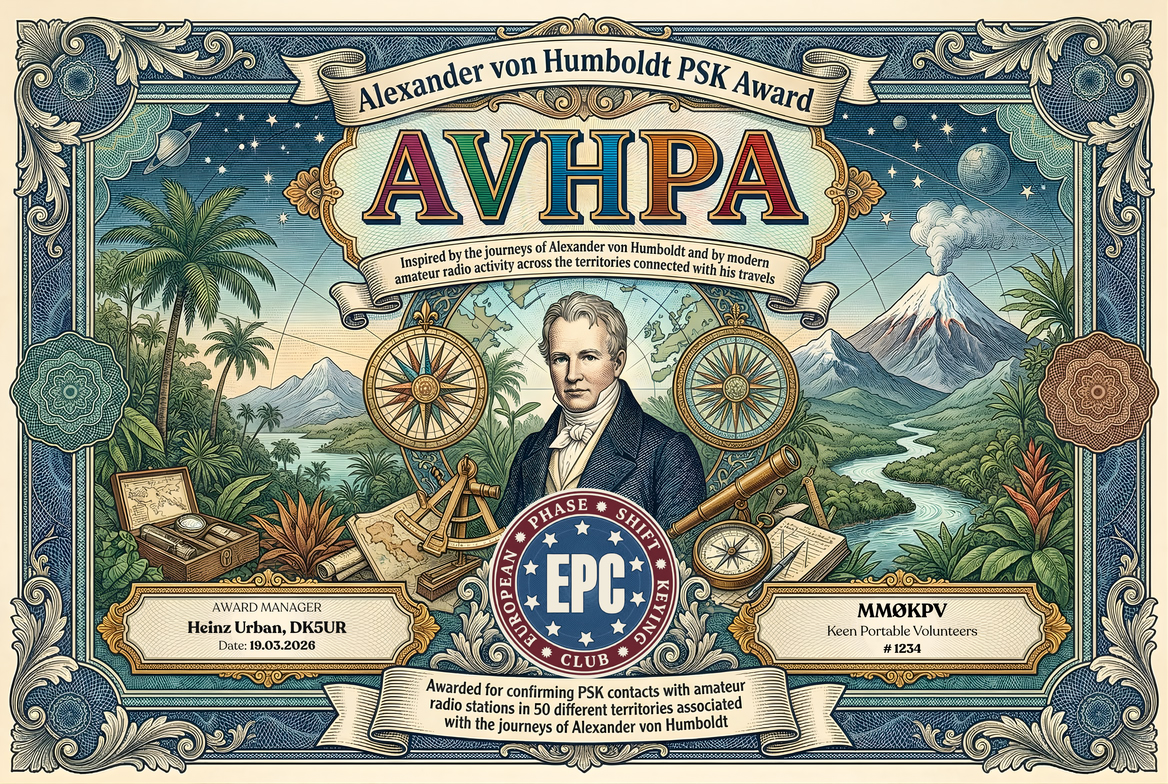
To qualify, an applicant must submit an ADIF log showing PSK QSOs with amateur radio stations from 50 different territories out of the 81 valid AVHPA territories listed below. Each territory counts once only. The idea is to recreate Humboldt’s extraordinary scientific path through today’s administrative geography and amateur-radio practice.
The AVHPA honors not only a historic traveler, but also the Humboldtian spirit of connection: observation across borders, comparison across landscapes, and the linking of distant places into one larger understanding of the world.
Creation date: 24.03.2026
- The AVHPA may be claimed by any licensed radio amateur, club station, or eligible SWL / DMS operator under the applicable EPC general rules.
- All operation must comply with the operator’s licence conditions and the relevant award framework.
- The applicant must provide evidence of having contacted amateur radio stations from any 50 different valid AVHPA territories listed in the table below.
- The valid list contains 81 territories in total.
- Each territory counts only once toward qualification.
- Contacts must be documented in ADIF format.
- It is a mandatory requirement that the applicant adds territory references in the COMMENT field of the ADIF file in the format #AVHPA AVH01 ... AVH81, so that the UltimateAAC Award Management Software can process the log properly.
- Only PSK contacts are valid for this award.
- Any PSK variant and any baud rate may be used.
- Credit is valid on amateur bands below 54 MHz.
- Mixed-band submissions are permitted.
- This award is based on a defined AVHPA territory list rather than a single DXCC-entity requirement.
- The list combines modern administrative units and a small number of historically established regional designations used for practical award administration.
- Each valid territory is connected to a documented part of Humboldt’s lifetime travel route, residence, embarkation point, scientific base, or field expedition.
- Qualification is based solely on the valid AVHPA territory list shown below.
| Prefix | Territory | AVHPA Code | Modern Type | How it relates to Alexander von Humboldt |
|---|---|---|---|---|
| CO2 | La Habana | AVH01 | Province | Havana was one of Humboldt’s major Caribbean bases. He stayed there during both Cuban phases of the American expedition and used the city as a scientific, political and publishing hub. |
| CO3 | Mayabeque | AVH02 | Province | This province represents the Batabanó corridor south of Havana, part of Humboldt’s documented movement through western Cuba during his island studies. |
| CO5 | Matanzas | AVH03 | Province | Matanzas is tied to Humboldt’s Cuban work on economy, landscape and plantation geography in the western-central part of the island. |
| CO6 | Sancti Spíritus | AVH04 | Province | Sancti Spíritus counts for the Trinidad region, which Humboldt visited while examining Cuba’s sugar economy and colonial society. |
| DL | Bavaria | AVH05 | State | Bavaria is included for Humboldt’s 1795 mining and geological journey through Bayreuth, Berneck and the Fichtelgebirge district. |
| DL | Berlin | AVH06 | State | Berlin was Humboldt’s birthplace, later residence and final home, so it belongs to the award route from the beginning and end of his life. |
| DL | Brandenburg | AVH07 | State | Brandenburg represents the Tegel / Berlin surroundings and the Frankfurt (Oder) area connected with Humboldt’s early education and family sphere. |
| DL | Lower Saxony | AVH08 | State | Lower Saxony counts for Göttingen, where Humboldt studied and formed key scientific friendships before his great expeditions. |
| DL | Saxony | AVH09 | State | Saxony is linked to Freiberg and later Dresden, central places in Humboldt’s mining training and scientific development. |
| EA1 | Galicia | AVh70 | Autonomous community | Galicia is included because Humboldt sailed from A Coruña in 1799 when he finally left Europe for the American expedition. |
| EA3 | Catalonia | AVh71 | Autonomous community | Catalonia represents Barcelona, one of the principal Spanish stages on Humboldt’s overland route before embarkation for the New World. |
| EA4 | Castilla–La Mancha | AVh72 | Autonomous community | Castilla–La Mancha counts because Humboldt crossed this interior Spanish region on the route between the Mediterranean coast and Madrid. |
| EA4 | Madrid | AVh73 | Autonomous community | Madrid was essential to the expedition: here Humboldt obtained crucial royal permission and prepared the American voyage. |
| EA5 | Valencia | AVh74 | Autonomous community | Valencia marks another clearly documented stage on Humboldt’s 1799 journey across Spain toward Madrid and the Atlantic coast. |
| EA8 | Canary Islands | AVh75 | Autonomous community / island group | The Canary Islands are included for Humboldt’s famous stop on Tenerife, where he climbed Teide before crossing the Atlantic. |
| F | Île-de-France | AVh76 | Region | Île-de-France counts for Paris, the city that became Humboldt’s principal intellectual base for much of his mature scientific life. |
| F | Nouvelle-Aquitaine | AVh77 | Region | Nouvelle-Aquitaine is included for Bordeaux, the French port region through which Humboldt returned to Europe in 1804. |
| F | Occitanie | AVh78 | Region | Occitanie marks the Nîmes–Montpellier–Perpignan route used by Humboldt during his southbound journey across France. |
| F | Provence–Alpes–Côte d’Azur | AVh79 | Region | This region counts for Marseille and Toulon, major Mediterranean stages in Humboldt’s pre-expedition travel. |
| HC1 | Pichincha | AVh80 | Province | Pichincha is one of Humboldt’s signature territories: it includes Quito and the volcanic highlands from which many Andean studies began. |
| HC2 | Guayas | AVh81 | Province | Guayas counts for Guayaquil, the key Pacific port from which Humboldt departed Ecuador for the next stage of his American journey. |
| HC3 | Loja | AVh82 | Province | Loja is tied to Humboldt’s work on cinchona and Andean vegetation in the southern Ecuadorian highlands. |
| HC6 | Cotopaxi | AVh83 | Province | Cotopaxi province is included for Humboldt’s observations in the great volcanic belt south of Quito. |
| HC6 | Chimborazo | AVh84 | Province | Chimborazo is central to Humboldt’s legend because his celebrated ascent there became one of the iconic episodes of scientific exploration. |
| HC7 | Napo | AVh85 | Province | Napo represents Humboldt’s travel and observations in the eastern Andean / Amazonian flank associated with Antisana and adjoining routes. |
| HK1 | Bolívar | AVh86 | Department/State | Bolívar Department counts for Cartagena, Turbaco and Mompox, key Caribbean and Magdalena-route stages of Humboldt’s New Granada journey. |
| HK3 | Bogotá | AVh87 | Capital district | Bogotá counts for New Granada’s capital, where Humboldt met leading scholars and gathered information that shaped his American publications. |
| HK6 | Tolima | AVh88 | Department | Tolima is included for Honda, the crucial river gateway on Humboldt’s ascent inland from the Caribbean toward Bogotá. |
| HK6 | Quindío | AVh89 | Department | Quindío counts for the famous Quindío crossing through the Andes, one of the most demanding overland legs of Humboldt’s New Granada route. |
| I8 | Campania | AVh90 | Region | Campania belongs on the list for Naples and Vesuvius, where Humboldt pursued volcanic observations after the American expedition. |
| IØ | Lazio | AVh91 | Region | Lazio counts for Rome, one of the principal Italian stops on Humboldt’s 1805 journey. |
| K3 | Pennsylvania | AVh92 | State | Pennsylvania is included for Philadelphia, the leading American scientific city Humboldt visited in 1804. |
| K3 | District of Columbia — Washington, D.C. | AVh93 | Territory | Included in the AVHPA because Humboldt’s documented travels passed through or were based in this territory. |
| K4 | Virginia | AVh94 | State | Virginia represents the Potomac / Mount Vernon side of Humboldt’s short U.S. visit linked with the Washington area. |
| ME | Bristol | AVh95 | Ceremonial county / city | Bristol counts because Humboldt’s 1790 journey through England included this major western port and commercial city. |
| ME | Buckinghamshire | AVh96 | Ceremonial county | Buckinghamshire is included for the English travel route associated with the country-house and scientific network Humboldt visited in 1790. |
| ME | Derbyshire | AVh97 | Ceremonial county | Derbyshire counts for Humboldt’s observations in England’s industrial and geological districts during the 1790 journey. |
| ME | Greater London | AVh98 | Metropolitan region | Greater London was the main English base of Humboldt’s 1790 visit and connected him to scientific and political circles. |
| ME | Oxfordshire | AVh99 | Ceremonial county | Oxfordshire belongs on the route as part of Humboldt’s documented 1790 movement through southern England’s scholarly landscape. |
| ME | Somerset | AVH40 | Ceremonial county | Somerset counts for the west-country leg of Humboldt’s first English journey, where he observed rural and industrial life. |
| ME | Warwickshire | AVH41 | Ceremonial county | Warwickshire represents part of Humboldt’s inland English route through the Midlands in 1790. |
| ME | West Midlands | AVH42 | Metropolitan county | The West Midlands are included because Humboldt passed through the industrial heartland of England on his 1790 study tour. |
| OA2 | Cajamarca | AVH43 | Region | Cajamarca is tied to Humboldt’s Peruvian route through the northern Andes and the Hualgayoc mining district. |
| OA2 | La Libertad | AVH44 | Region | La Libertad counts for Trujillo and the nearby archaeological and coastal zone Humboldt visited in northern Peru. |
| OA4 | Lima | AVH45 | Region / metropolitan area | Lima is included for Humboldt’s scientifically important stay in the Peruvian capital, especially his coastal and oceanographic observations. |
| OE1 | Vienna | AVH46 | State | Vienna was a documented stage on Humboldt’s central European travels before the American expedition. |
| OE2 | Salzburg | AVH47 | State | Salzburg is included for the same 1797–1798 central European route that took Humboldt through the Alpine world. |
| OK1 | Bohemia | AVH48 | Historical region | Bohemia counts for Prague and the overland route through the Habsburg lands on Humboldt’s journey toward Vienna. |
| R1A | Saint Petersburg | AVH49 | Federal city | Saint Petersburg was the formal starting point and one of the major administrative centers of Humboldt’s 1829 Russian expedition. |
| R2F | Kaliningrad | AVH50 | Oblast | Kaliningrad represents the historic East Prussian / Baltic approach and the Curonian-Spit sector associated with Humboldt’s eastward journey into the Russian Empire. |
| R3A | Moscow | AVH51 | Federal city | Moscow was one of the major cities visited on the 1829 expedition and a key stage on the road east. |
| R3P | Tula | AVH52 | Oblast | Tula counts as part of Humboldt’s well-documented movement through central Russia during the 1829 journey. |
| R3T | Nizhny Novgorod | AVH53 | Oblast | Nizhny Novgorod was an important Volga stage on Humboldt’s route toward the Urals and inner Asia. |
| R4P | Tatarstan | AVH54 | Republic | Tatarstan counts for Kazan, a major scholarly and administrative stop on Humboldt’s 1829 route. |
| R6U | Astrakhan | AVH55 | Oblast | Astrakhan represents the lower Volga / Caspian extension of Humboldt’s Russian journey. |
| R9A | Chelyabinsk | AVH56 | Oblast | Chelyabinsk belongs on the list because Humboldt crossed the southern Ural zone during his mining and geological investigations. |
| R9C | Sverdlovsk | AVH57 | Oblast | Sverdlovsk counts for Yekaterinburg and the northern Ural mining districts, central targets of the 1829 expedition. |
| R9F | Perm | AVH58 | Krai | Perm represents the western-Ural sector traversed during Humboldt’s geological and mining tour. |
| R9L | Tyumen | AVH59 | Oblast | Tyumen is included for Tobolsk and western Siberia, major stations on Humboldt’s eastward route. |
| R9M | Omsk | AVH60 | Oblast | Omsk marks Humboldt’s movement farther into western Siberia during the Russian expedition. |
| R9S | Orenburg | AVH61 | Oblast | Orenburg counts for the southern-Ural steppe gateway on Humboldt’s 1829 journey. |
| R9Y | Altai Krai | AVH62 | Krai | Altai Krai is included because Humboldt traveled into the Altai mining region, one of the eastern high points of the expedition. |
| R9Z | Altai Republic | AVH63 | Republic | The Altai Republic represents the broader Altai mountain world associated with Humboldt’s Siberian fieldwork. |
| UN-D | Abai Region | AVH64 | Region | Abai Region counts for the Semey / eastern Kazakh steppe side of Humboldt’s farthest eastward travels in 1829. |
| XE1 | Morelos | AVH65 | State | Morelos is included for Cuernavaca, one of the places Humboldt visited in central Mexico. |
| XE1 | Mexico City | AVH66 | Federal entity | Mexico City was one of Humboldt’s most important bases in New Spain, where he assembled data that later fed his great political and scientific works. |
| XE1 | Guanajuato | AVH67 | State | Guanajuato counts for the Valenciana mining district, a crucial site in Humboldt’s study of New Spain’s economy and geology. |
| XE1 | Michoacán | AVH68 | State | Michoacán is tied to Humboldt’s visit to the Jorullo volcanic region, important for his volcanological work. |
| XE1 | Puebla | AVH69 | State | Puebla belongs on the route because Humboldt passed through it on the inland road between Mexico City and Veracruz. |
| XE1 | Veracruz | AVH70 | State | Veracruz counts for the coastal entry-and-exit corridor of New Spain, including the Xalapa route and Humboldt’s return to the Atlantic. |
| XE1 | Hidalgo | AVH71 | State | Hidalgo is included for the Pachuca / Real del Monte and Santa María Regla mining districts associated with Humboldt’s Mexican research. |
| XE3 | Guerrero | AVH72 | State | Guerrero counts for Acapulco and Taxco, both major stages in Humboldt’s Mexican itinerary. |
| YV4 | Aragua | AVH73 | State | Aragua represents the Lake Valencia district, one of the best-known landscapes Humboldt analyzed in Venezuela. |
| YV5 | Caracas | AVH74 | Capital district / city | Caracas was a major Venezuelan base from which Humboldt planned excursions and gathered political and scientific information. |
| YV5 | Miranda | AVH75 | State | Miranda counts for the coastal corridor east of Caracas, including Higuerote and adjoining stages of the Venezuelan journey. |
| YV5 | Guárico | AVH76 | State | Guárico represents the llanos interior around Calabozo, where Humboldt made classic observations on plains ecology and electric eels. |
| YV6 | Bolívar | AVH77 | Department/State | Bolívar state is included for Angostura (today Ciudad Bolívar), a major Orinoco stage near the end of Humboldt’s Venezuelan river expedition. |
| YV7 | Sucre | AVH78 | State | Sucre counts for Cumaná, Humboldt’s first mainland landing in South America and one of the foundational sites of the American expedition. |
| YV8 | Monagas | AVH79 | State | Monagas is included for Caripe and the Cueva del Guácharo region visited during Humboldt’s Venezuelan explorations. |
| YV9 | Apure | AVH80 | State | Apure counts for San Fernando de Apure and the river route that led Humboldt toward the Orinoco basin. |
| YV9 | Amazonas | AVH81 | State | Amazonas is one of Humboldt’s defining territories, covering the upper Orinoco–Casiquiare–Río Negro sector of his great river journey. |
Note: Qualification for the AVHPA is based only on working 50 different territories from the valid AVHPA list above. The award title honors Alexander von Humboldt and the geography of his documented journeys; administration is based on the modern territory list shown here.
