
The David Livingstone PSK Award (DLPA) honors the life, travels and geographical legacy of the Scottish missionary, physician and explorer David Livingstone. The award is based on modern territories linked to places where Livingstone was born, educated, prepared for missionary work, landed on his ocean voyage, lived, traveled, explored, crossed, or died.
For the DLPA, qualification is intentionally defined through a practical modern territory list using today’s regions, provinces, states, islands and amateur radio call areas. This approach allows radio amateurs to follow Livingstone’s route through the modern map rather than through changing nineteenth-century political boundaries.
To qualify, an applicant must submit an ADIF log proving PSK QSOs with amateur radio stations from 15 different territories out of the 18 valid DLPA territories listed below.
The award commemorates the exploration theme within amateur radio and celebrates the enduring link between historical travel routes and modern international on-air activity.
Creation date: 23.03.2026
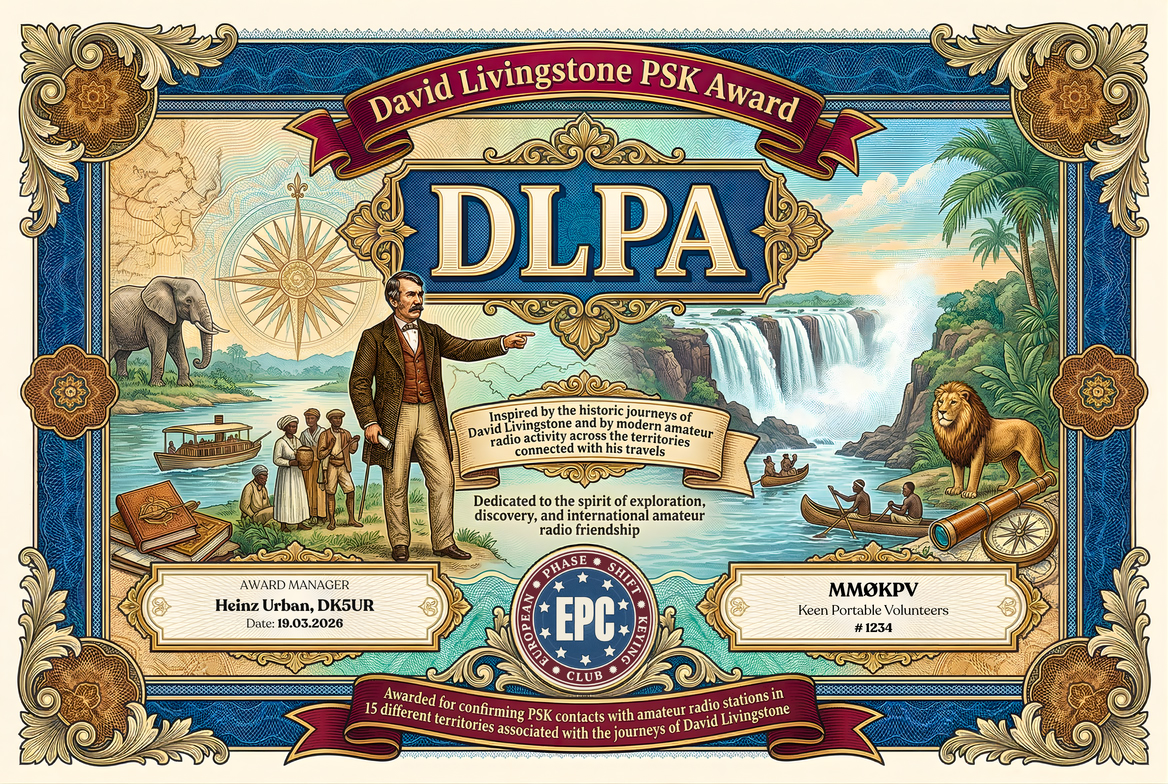
- The DLPA may be claimed by any licensed radio amateur, club station, or eligible SWL/DMS operator under the applicable EPC general rules.
- All operation must comply with the operator’s licence conditions and the relevant award framework.
- The applicant must provide evidence of having contacted amateur radio stations from any 15 different valid DLPA territories listed in the territory table below.
- The valid list contains 18 territories in total.
- Each territory counts only once toward the qualification total.
- It is a mandatory requirement that each claimed QSO carries the matching territory reference in the COMMENT field, for example #DLPA DLAN ... #DLPA DLZB
- Contacts must be documented in ADIF format.
- Only PSK contacts are valid for this award.
- Any PSK variant and any baud rate may be used.
- Credit is valid on amateur bands below 54 MHz.
- Mixed-band submissions are permitted.
- This award is based on a defined DLPA territory list rather than on a single DXCC-entity requirement.
- The list combines modern islands, provinces, regions, states and territorial call areas connected with David Livingstone’s life and expeditions.
- For call areas and regional prefixes, the territory is counted according to the specific designation shown in the table below.
- Qualification is based solely on the valid DLPA territory list and not on historical sovereignty or expedition chronology alone.
| Prefix | Territory | DLPA Code | Modern Type | How it relates to David Livingstone |
|---|---|---|---|---|
| 5H1 | Zanzibar Island | DLZB | Island | Zanzibar became a major East African base linked to the later phase of Livingstone’s journeys and search operations. It formed part of the coastal gateway through which expeditions, supplies and communication connected with his central African travels. |
| 5H | Tanzania (Mainland) | DLTZ | Mainland territory | Livingstone traveled in what is now mainland Tanzania, notably through the interior around Ujiji on Lake Tanganyika and later Tabora, during the final years of his explorations. |
| 7Q | Malawi | DLMW | Country | Livingstone explored the Shire River and the Lake Nyasa region, making present-day Malawi one of the most important territories associated with his anti-slavery and exploration work. |
| 9J | Zambia | DLZA | Country | Zambia stands at the heart of the Livingstone story: he reached and described Victoria Falls from the north bank area, traveled widely along the Zambezi system, and died in what is now central Zambia at Chitambo. |
| 9Q | Democratic Republic of the Congo | DLCO | Country | Livingstone entered the Congo basin in the course of his final expeditions and reached places such as Nyangwe on the Lualaba, central to the geographical puzzle of the Nile and Congo watersheds. |
| A2 | Botswana | DLBS | Country | Livingstone lived and worked for years in what is now Botswana, including Kolobeng, and crossed major interior routes there on his way toward Lake Ngami and the upper Zambezi corridor. |
| C9 | Mozambique | DLMO | Country | Mozambique was crucial to Livingstone’s Zambezi Expedition. He traveled through the Zambezi valley and used ports and river stations in what is now Mozambique as access routes inland. |
| D2 | Angola | DLAN | Country | Livingstone achieved a landmark trans-African journey by reaching Luanda on the Atlantic coast in Angola after crossing the interior from southern-central Africa. |
| ME | Essex (England) | DLES | County / region | Essex is included because Livingstone trained for missionary service at Chipping Ongar before departing for Africa, making it one of the formative locations of his career. |
| ME | Greater London (England) | DLLO | Metropolitan region | London was central to Livingstone’s education, church and missionary connections, public reception, and later support network through the London Missionary Society and related institutions. |
| MM | Glasgow City (Scotland) | DLGL | City council area | Glasgow is one of Livingstone’s key home territories because he studied there and developed the medical training that accompanied his later missionary and exploratory work. |
| MM | South Lanarkshire (Scotland) | DLSL | Council area | South Lanarkshire includes Blantyre, David Livingstone’s birthplace, and therefore represents the starting point of his life story. |
| PY1 | Rio de Janeiro | DLRJ | State / port region | Livingstone briefly visited Rio de Janeiro on the outward sea voyage to Africa, making Brazil a short but genuine part of his traveled route. |
| Z2 | Zimbabwe | DLZM | Country | Zimbabwe is linked to the Victoria Falls region on the south bank of the Zambezi gorge. In award terms it represents the opposite side of the falls landscape that became permanently associated with Livingstone’s name. |
| ZS1 | Western Cape (South Africa) | DLWC | Province | Western Cape is included because Livingstone arrived at Cape Town, the main southern African entry point from which his inland career began. |
| ZS2 | Eastern Cape (South Africa) | DLEC | Province | Eastern Cape represents the Algoa Bay corridor, part of the early South African route system connected with mission travel and overland movement during Livingstone’s first years in the region. |
| ZS3 | Northern Cape (South Africa) | DLNC | Province | Northern Cape is vital because Kuruman, one of the best-known early mission stations associated with Livingstone and Robert Moffat’s sphere, lies there. |
| ZS6 | North West (South Africa) | DLNW | Province | North West is tied to Livingstone’s interior mission years in the southern African frontier zone, including the Mabotsa area and routes toward Bechuanaland. |
Note: Qualification for the DLPA is based only on working 15 different territories from the valid DLPA list above. The award title honors David Livingstone and the geography of his travels; administration is based on the modern territory list shown here.
